Key Business Reports Every Entrepreneur Needs to Track
Direct answer: If Key Business Reports you own a business, the five most important reports are sales, purchases, customer/vendor outstandinoutstanding, GST summary, an GST summary, and stock.d stock. They tell you what's coming in, what's going out, who owes you money, how much you owe, and whether or not you're in compliance.
Most entrepreneurs do not lack information; rather, they lack a clear understanding of the facts they already have. A transaction is billed, a payment is received later, and goods is removed from the shelves, and each of these events is documented somewhere, but rarely in a way that allows you to stand back and examine the entire business at once. That is exactly what gap reports are intended to do: provide a useable picture of data that you currently generate on a daily basis.
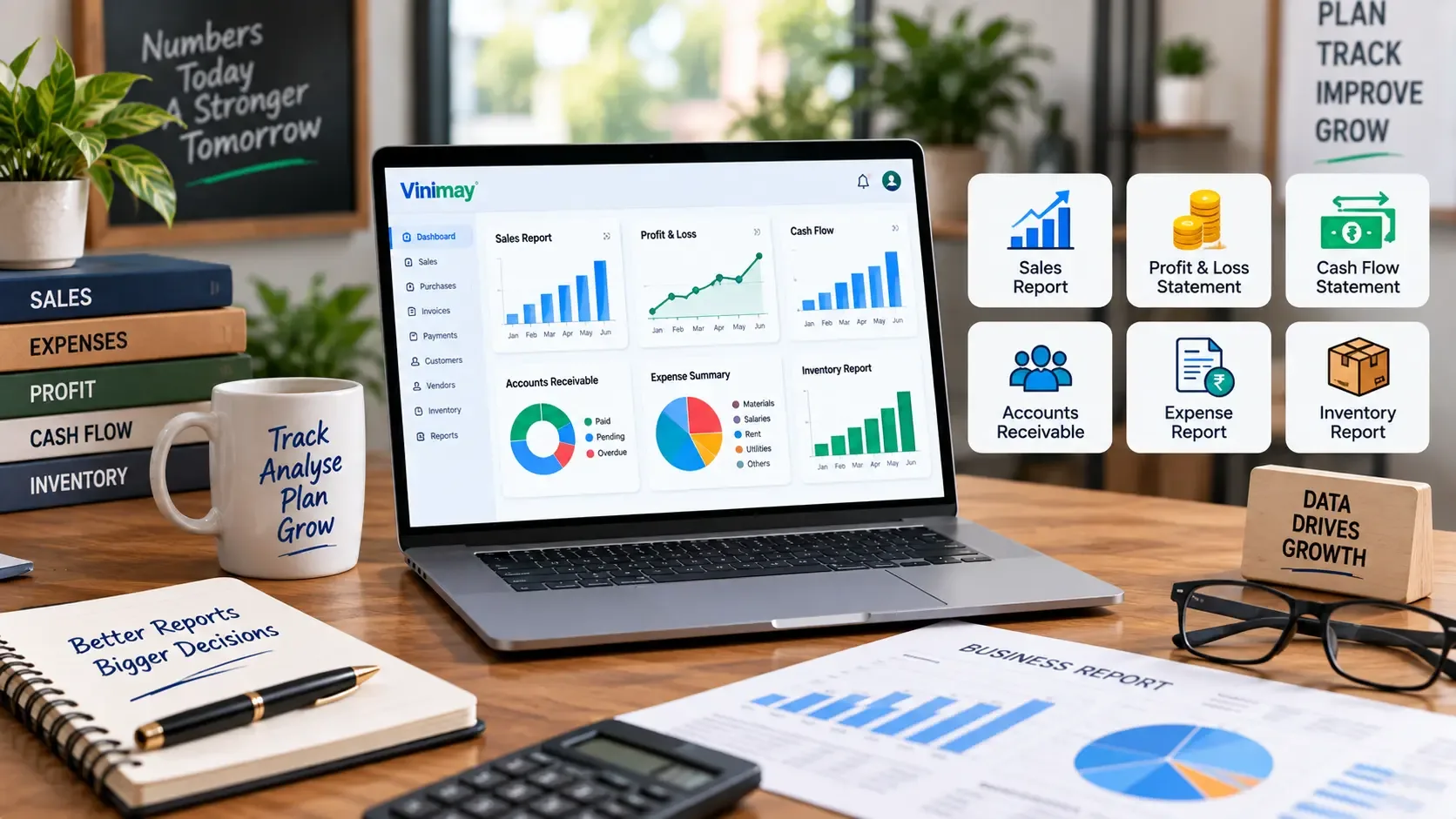
This is also where the right software makes a real, practical difference rather than just a convenient one. When your invoices, payments, purchases, and stock are already recorded in a connected system—the way Vinimay records them—a report isn't something you build from scratch at month-end. It's simply a summary of transactions that were already accurate the moment they were entered. That difference is what separates a business owner confidently checking numbers in five minutes from one spending an evening reconstructing them from a notebook and three spreadsheets.
Why Reports Matter More Than Gut Feeling
Running a business on a daily basis feels hectic, even when anything is quietly going wrong. A customer failing to pay on time, a supply running low, and a minor GST mismatch appearing on invoice after invoice—none of these stand out in the daily hustle of billing and serving customers. Reports detect these patterns exactly because they step back from the day-to-day and examine totals, trends, and balances across time, something a single transaction never does on its own.
The Five Reports That Actually Matter
Each of these answers a different question, and none of them substitutes for another. A strong sales report with a weak outstanding report still leaves you blind to cash actually sitting uncollected.
What Happens Without These Reports
Outstanding gets missed—a customer's unpaid invoice sits unnoticed for months, quietly becoming harder to collect the longer it goes unchecked.
GST errors compound—small tax-split mistakes on individual invoices go unnoticed until filing time, when correcting them is far more work than catching them early.
Stock decisions get made blind—reordering happens on guesswork instead of actual movement data, leading to both stockouts and dead inventory.
Cash flow surprises hit hard—money owed to suppliers is forgotten until a payment is overdue, straining relationships that took time to build.
What Makes a Report Actually Useful
A report is only as good as the data that supports it. If sales, purchases, and payments have already been recorded in one connected system, making a report is simply drawing a summary from figures that were correct from the moment they were entered. If those same records are split over a notebook, a payment diary, and a separate stock count, creating any of the five reports listed above requires manually collecting and reconciling numbers first—at which point the report is only as dependable as the physical labor that went into its creation.
How Vinimay Turns Everyday Billing Into Usable Reports
This is precisely the issue Vinimay is designed to address. Because sales, purchases, receipts, and payments are logged against your customer and vendor accounts as they occur rather than compiled later, the outstanding tracking and transaction history described above are derived directly from the same related data via Vinimay's payment ledger. A customer's outstanding balance or a supplier's dues are not independent calculations that run once a month;
They are updated whenever a new transaction is recorded. If you want to experience this for yourself before making a decision, Vinimay's free tool allows you to generate up to 5 GST-compliant invoices without joining up—enough to get a sense of how transactions flow into a connected record. Specific formal reports beyond this, such as a full profit and loss statement or balance sheet, are not currently confirmed for Vinimay, so if that level of financial statement reporting is a critical requirement for your company, it's worth checking current capability directly rather than assuming it's covered.
[Create Your First Invoice Free with Vinimay]
Conclusion
Reports aren't an extra task layered on top of running a business—they're the difference between reacting to problems after they've grown and catching them while they're still small. Sales, purchases, outstanding, GST, and stock cover the core of what any entrepreneur needs to stay on top of, and none of them need to be a burden if the underlying transactions are already recorded properly.
The real decision isn't whether to check reports—it's whether your day-to-day billing is set up to make those reports trustworthy the moment you need them., vyapar billing software
Ready to connect billing and stock? Try Vinimay free: create up to 5 GST invoices, track inventory in real time, and download professional PDFs in seconds. Have questions? Chat with us on WhatsApp.
FAQs
What's the single most important report for a small business?
There isn't one—sales, outstanding, and GST summary all matter for different reasons, and skipping any one of them leaves a genuine blind spot in how the business is actually performing.
How often should I check my outstanding report?
Weekly is reasonable for most small businesses — monthly often means a payment issue has already had a month to grow before you notice it.
Do I need a formal profit and loss statement, or are basic reports enough?
For running the business day to day, sales, purchase, outstanding, GST, and stock reports cover most decisions. A formal P&L becomes necessary when preparing for a loan application, an investor conversation, or year-end filing with your CA.
Can reports be generated automatically, or do I need to compile them myself?
If your transactions are already recorded in one connected system, reports can be pulled directly from that data. If records are scattered across different places, you'd need to manually compile them first, and the report is only as accurate as that manual work.
Does Vinimay generate a balance sheet or profit and loss report?
Not currently confirmed. Vinimay's confirmed scope covers GST-compliant invoicing, transaction recording, customer/vendor outstanding tracking through its payment ledger, and inventory sync—the everyday data that most of these five reports are built from.
Related Topics
Published by admin
Our editorial and compliance specialists create practical guides, tax calculation rules, and operational strategies to empower Indian small business owners and accountants.